2 Examples And Preliminary Results
2.1 Outputs from earlier surveys
CEEMID grew out of a relatively data poor, and low-royalty income emerging region, and most of our work was to justify higher royalties and private copying compensation for artists. Another important aim was to show the difficulties of the lives of music technicians, and the overtaxation of live music particularly in Hungary, Slovakia and Croatia.
Since the publication of the The first Hungarian music industry rerpot we had been supporting local stakeholders to justify higher royalty and compensation levels, so far, successfully, and we have repeated the survey every year between 2014-2019.
In Slovakia, Slovak music industry report, since we started the work in 2015, royalty levels went up significantly, there is a functional private copying remuneration mechanism present, and we had been re-running the surveys regularly. We have been able to advocate for more cultural enterprise friendly economic and tax policies.
In Croatia, we created advocacy material for updating the compensation system with Private Copying in Croatia.
In Czechia, we showed the different career paths of Czech and Austrian artists to become financially independent, and pinpointed some weaknesses of an emerging markets growth path.
The Central European Music Industry Report was a proof of concept that CI and CEEMID are able to produce pan-European, evidence based business and policy advocacy reports. It was highlighted as an example of good evidence-based policy work at the CCS Ecosystems: FLIPPING THE ODDS Conference – a high-level stakeholder event jointly organized by Goethe-Institute and DG Education, Youth, Sport and Culture of the European Commission.
2.2 Example findings: Comparisons of musicians’ economic well being
We ask our respondents standard attitude questions, which allows us to gauge the sentiment of musicians in comparison with their colleagues in other countries, and also with other professional groups, such as office workers, doctors, managers in their own countries.
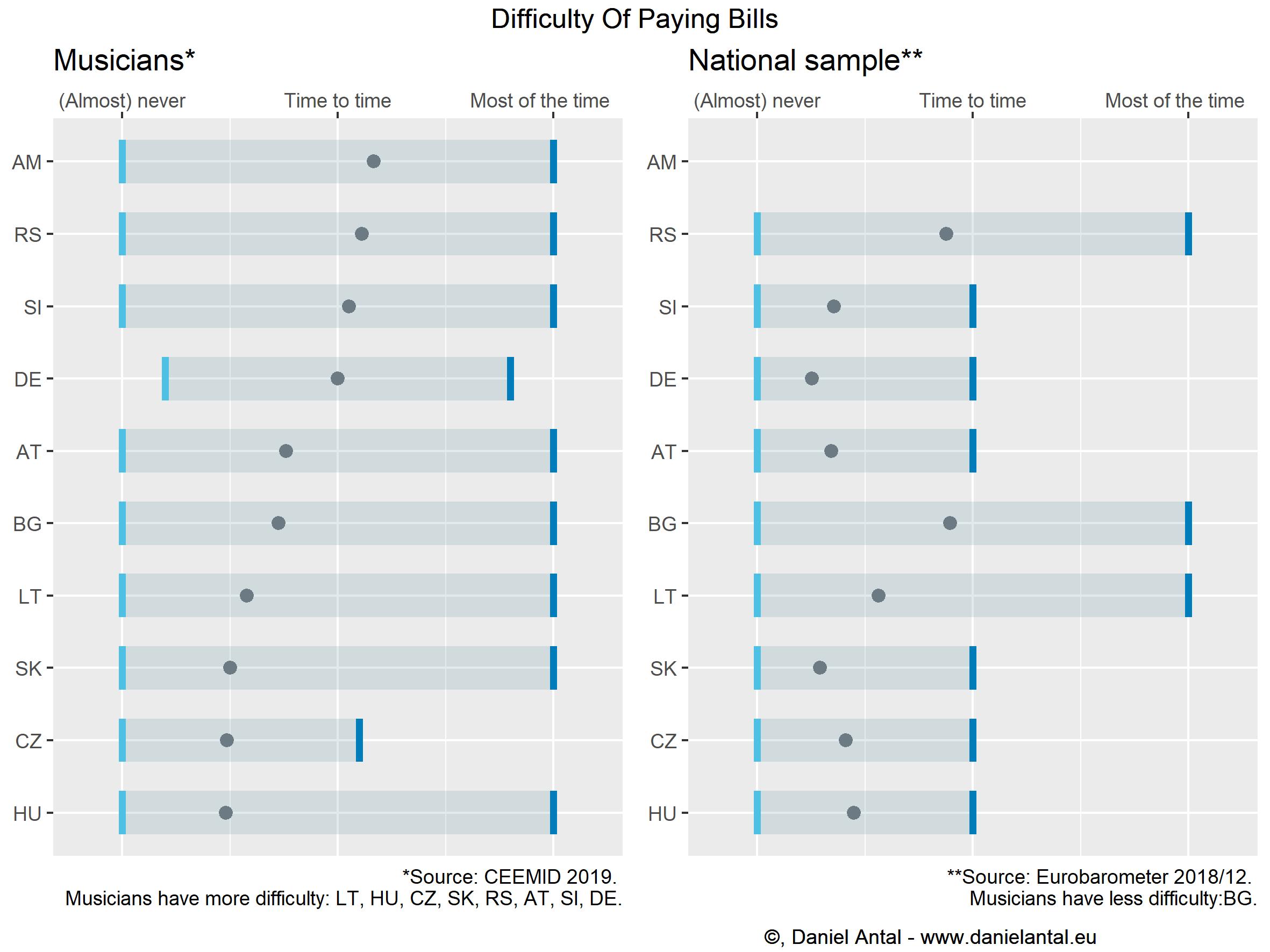
In order to get a high-level comparison among the living standards of musicians, we use the standard survey question used in Eurobarometer surveys for decades: how often has the respondent had difficulties with paying bills in the past year? This is a very good starting point because it makes comparable the rough material standards of musicians and other professional groups in the EU, irrespective of local earnings and living costs.
Musicians everywhere, including in rich countries like Germany, Austria and Slovenia have more problems with paying their bills than the general population in their countries. The only seemingly different country is Bulgaria, but in this case, the self-reported difference is small, and generally Bulgarian musicians and other Bulgarian people have similarly frequent difficulties with paying their bills.
Working in an emerging economy is more stressful than in a mature economy – making ends is more difficult, risks are greater and usually rules change faster. No wonder that people generally report higher level of life satisfaction in countries where the living standards are also higher: average life satisfaction in a country is greatly influenced by national income and general health level, measured by life expectancy.
However, it is also recorded since the 1970s that after reaching a certain level of living standards, life satisfaction does not increase further with economic conditions. Other factors, such as vocation, work-life balance and political factors play a role, too. Working in an emerging economy is more stressful than in a mature economy – making ends is more difficult, risks are greater and usually rules change faster.
In the emerging music business countries, it is very important to see that the musicians not only earn little money, but as freelancers their income is mainly based on live performances, peaking in the festival season and in December. This income is usually taxed at far higher rates in the CEE region than in Western Europe or in non-creative industries. Royalties, which should balance variable live performance earnings are far lower both as a percentage of total musician income and in euro terms than in advanced markets. This is often coupled with higher taxation, too.
To avoid the bias of higher satisfaction levels in richer environments, we measure musician’s self-reported life satisfaction levels against the national averages from the 2018/11 Eurobarometer sample, scaled between the numerical values of -2 (not at all satisfied) to 2 (very satisfied).
Our comparison shows that in most of our surveyed countries, musicians are more satisfied with their lives than the average person, despite having more material difficulties. Of course, age, and other factors can contribute to this, but a vocational calling is certainly an important aspect, too. The exceptions are, interestingly, Austria and Slovenia, where the general population has a very high level of life satisfaction, and where both musicians and the general public are generally more satisfied with their lives than in the other countries. In these cases, compared to the general population, music professional are less satisfied with their lives. In Serbia our sample is too small to draw real conclusions.
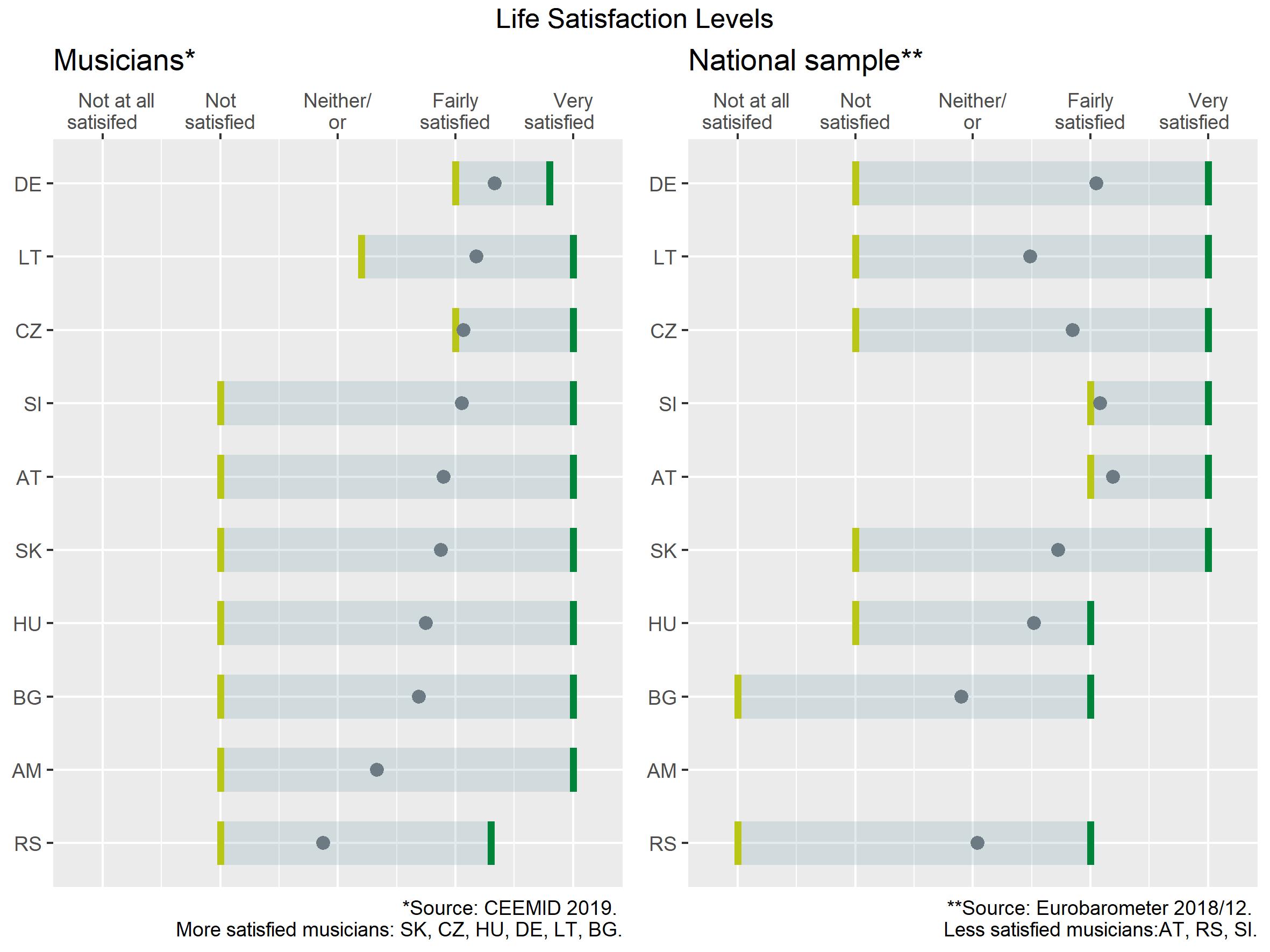
Career in music can lead to higher life satisfaction than other similarly paid jobs in Europe. However, music market stakeholders should focus on increasing the level of music professional earnings and reducing its variance within the year and over the years, because the material living conditions of musicians is significantly worse than the conditions of the general population.
2.3 Example findings: Where is the audience?
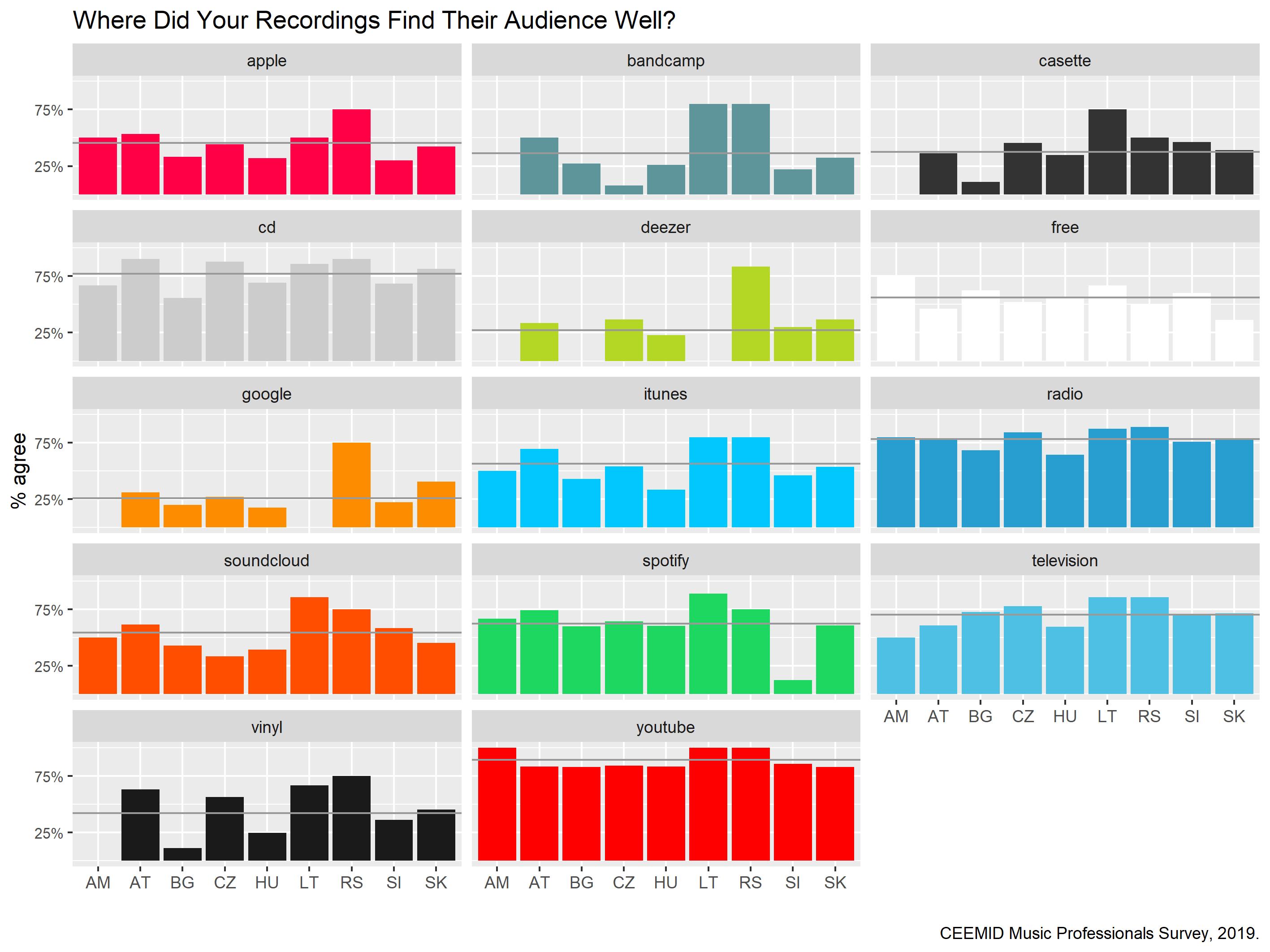
While payouts on YouTube are seen as problematic in Europe, in every surveyed country it is the best channel to connect with audiences. In emerging markets, where Spotify and Apple Music are either not present or very new, niche players like Bandcamp or smaller platforms like Deezer or Google Play have an important role.
Physical formats, especially vinyl and cassettes are making a comeback as high-value products. In genres where this configuration is expected, they can contribute very significantly to the sales. However, in some countries their sales infrastructure must be rebuilt.